Supplies for workshops
Check the registration page for workshop availability.
Because Undrawing is a very specific approach, it's helpful to use the specific materials recommended. This reduces the number of variables and increases the likelihood of quick understanding.
Pastels:
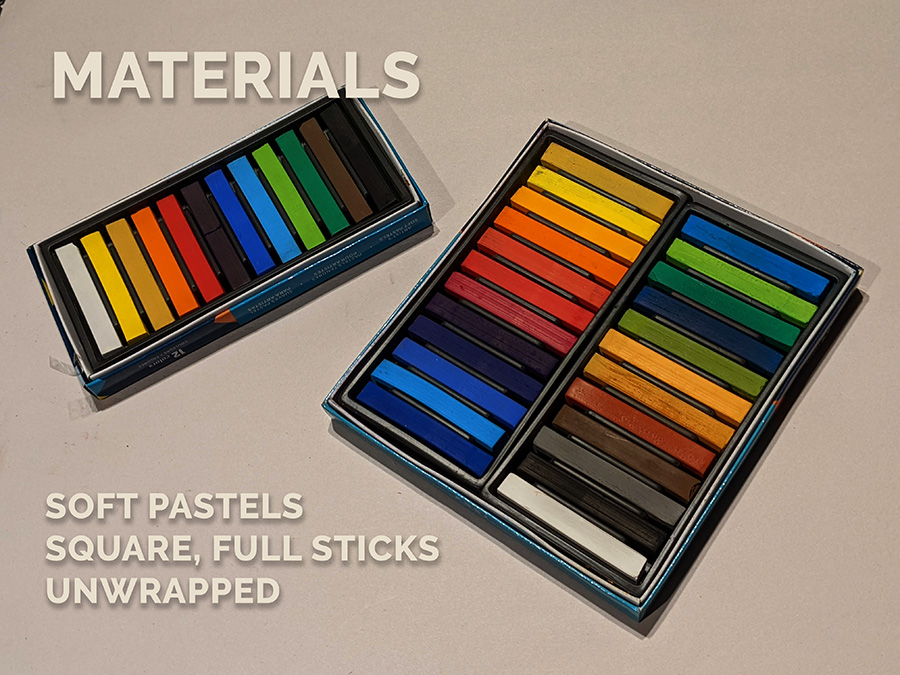
As we'll be using all parts of the pastel, we recommend square sticks with no wrapping. Common brands include ProArt, I Love Art, Jackson, and so forth. Look for sets of 12 or 24 in the US$5-15 range for a set. Note that these are soft pastels, NOT oil pastels. The square profile is important to achieve a wide variety of marks.
Higher-end pastels, like those from Sennelier, Schminke, Rembrandt, et al, are not recommended because their binder-to-pigment ratio makes them too crumbly, plus their round profile makes fine lines very difficult to achieve.
Note that Prismacolor Nupastel or Conte are not recommended, as they're small and relatively expensive (you'll go through these very quickly).
Paper:
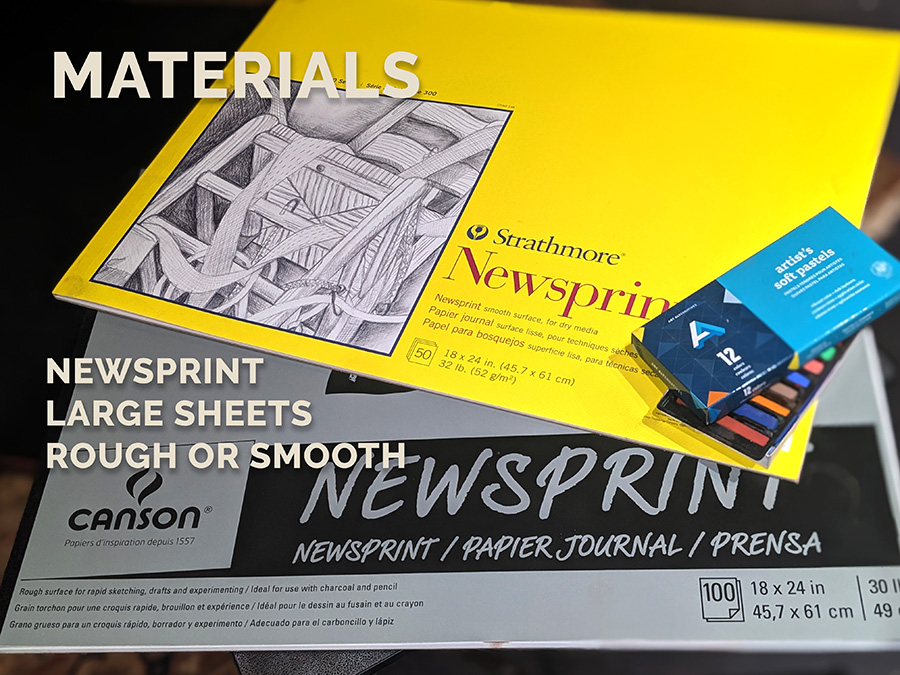
For Undrawing, we recommend large (18x24 or A2) sheets of newsprint. Lots of it. In a typical 3-4 hour workshop, you'll go through from 20 up to 50 sheets of paper, so a pad of 50 to 100 sheets is recommended.
The goal of Undrawing is less about have a frameable piece and more about accurate and expressive marks in the moment; the end result is like a milemarker on your journey to being able to see clearly and draw quickly with glee without feeling precious about any other outcome.
Other materials:
You'll need a drawing board and clips to secure the paper, in case the venue doesn't have enough to go around. We won't be using our fingers or stumps or other blending tools, but soft pastels are, well, soft, and your hands will get pastel-ly. You may opt to wear clothes that can get dirty, or maybe an apron. If you're leery of getting your hands dirty, you may also wear surgical gloves. Masks are not a bad idea when you're using pastels if you're sensitive to the dust.
Spray fixatives are typically used to fix pastel works, but in this workshop we're less concerned with creating finished pieces than we are with learning and practicing techniques. If you create something you want to save or continue to work on, wax paper, tissue paper, or Glassine can be used as a cover.